> For the complete documentation index, see [llms.txt](https://docs.vectra.ai/llms.txt). Markdown versions of documentation pages are available by appending `.md` to page URLs; this page is available as [Markdown](https://docs.vectra.ai/configuration/access/saml-sso-rux/keycloak-saml-rux.md).
# Keycloak SAML (RUX)
Enabling RUX (Respond UX) SAML SSO with Keycloak as the Identity Provider (IdP).
{% hint style="warning" %}
**Please Note:**
This article is **ONLY** for customers configuring SAML SSO for **Respond UX (RUX)** deployments using Keycloak **as the IdP**.
If you are using a Quadrant UX deployment with Keycloak, use the [Any IdP SAML (QUX)](/configuration/access/saml-sso-qux/any-idp-saml-qux.md) guide instead of this one.
While similar, there are some differences in the implementation for customers using the Quadrant UX. If you are unsure which UX you are using, please see: [Vectra Analyst User Experiences (Respond vs Quadrant) for more information](/deployment/getting-started/analyst-ux-options-rux-vs-qux.md).
The Respond UX requires different SAML claim names than the Quadrant UX when setting up SAML 2.0 based SSO but the claim creation process in the IdP is similar.
{% endhint %}
### Quadrant UX IdP Specific Articles
If you are configuring SAML for the Quadrant UX, please see the following articles (instead of this article):
* [Setup SAML SSO with any IdP (Quadrant UX)](/configuration/access/saml-sso-qux/any-idp-saml-qux.md)
* [Setup SAML SSO with Azure AD (Quadrant UX)](/configuration/access/saml-sso-qux/entra-id-azure-ad-saml-qux.md)
* [Setup SAML SSO with Okta (Quadrant UX)](/configuration/access/saml-sso-qux/okta-saml-qux.md)
* [Setup SAML SSO with ADFS (Quadrant UX)](/configuration/access/saml-sso-qux/adfs-saml-qux.md)
* [Setup SAML SSO with Ping Identity (Quadrant UX)](/configuration/access/saml-sso-qux/ping-identity-saml-qux.md)
## Introduction
* Customers can setup SSO federation to multiple SAML 2.0-based identity providers (IdP).
* For most customers, only a single IdP is required.
* Once federated, already authenticated users will have one-click login in to the Vectra Respond UX.
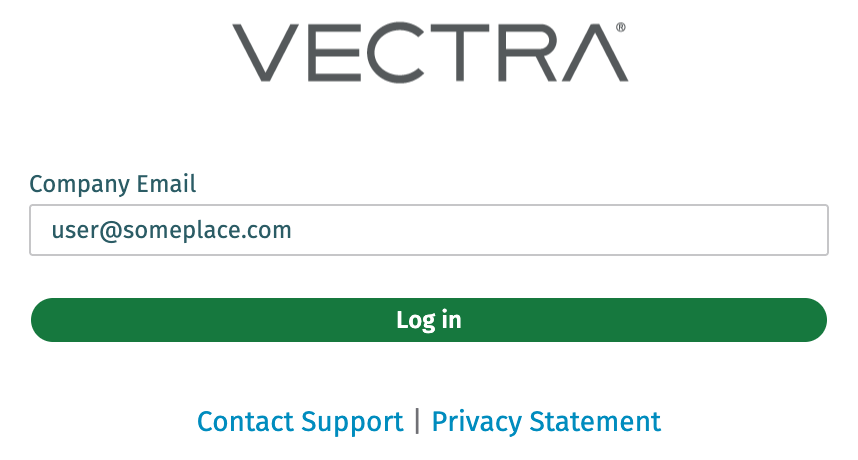
* If multiple IdPs are configured, and the user is not already authenticated, the user will need to enter their email address so the domain name mapping can direct the user to the appropriate IdP.
* Features like password policies and multi-factor authentication will be enforced by the IdP.
* Once authenticated, users are assigned the Vectra role defined for their user or group in the IdP.
* This will map to a role (and permissions) as defined in the Vectra UI.
## Multiple SAML Profile Support
Vectra now supports multiple SAML profiles. Not all customers will require this, and NO changes are required for existing single IdP SAML configurations.
{% hint style="info" %}
**Please Note:**
* Existing customers do **NOT** need to do anything if they will continue to only have a single SAML IdP configured.
* Any new profile that is added, for new or existing customers, will now need to have a **Domains** list configured as part of the Vectra SAML profile.
* If you add a 2nd profile to an existing deployment that did **NOT** have a **Domains** list configured previously, you **MUST** edit that existing profile to add the **Domains** mapping for that IdP.
* Nothing changes on the IdP side of the configuration.
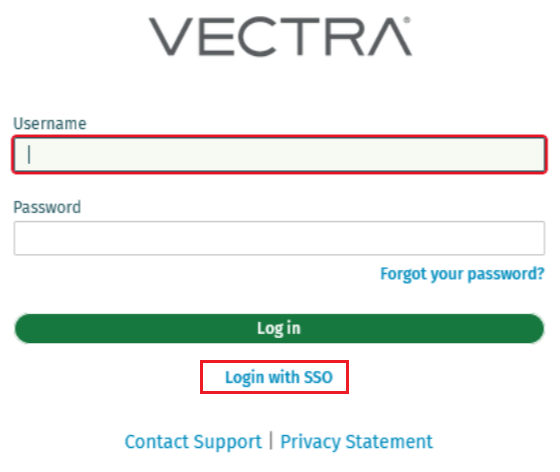
* When multiple profiles are configured, users will be asked to enter their email address to be redirected to the appropriate IdP when they click **Login with SSO** on the Vectra login screen.
{% endhint %}
## RUX SAML SSO - Notes of Interest
* **Please ensure the users are only mapped to one Vectra Role in the IdP.**
* At this time, if a user is mapped to more than 1 role in the IdP, the user may not successfully log in with the desired role.
* IdP initiated flows are **NOT** supported.
* While these flows may work, they are not recommended because they are highly susceptible to Man-in-the-Middle attack using stolen SAML assertions.
* Single Log Out (SLO) and IdP initiated log out are **NOT** supported.
* When a user logs out of the Respond UX, they are taken to a screen where they can log in locally or click a link to **Log in via SSO**.
* At this time, a user who successfully authenticates through their IdP to Vectra will have a session that is good for one day.
* Local user login that bypasses the SAML flow is still available by adding `/signIn?local=True` to the end of your Respond UX login URL.
* Example: `https://[unique_customer_id].uw2.portal.vectra.ai/signIn?local=True`
* If you are publishing the URLs of applications used in your environment on a dedicated app/page, you can publish the URL associated with the **Login with SSO** link to ensure users always use this path
* Token Encryption is currently **NOT** supported.
## SAML Service Provider (SP) Initiated Flow
* Please note that all communication that is associated with the SAML login process is brokered by the User Agent (user's browser). Vectra never needs to communicate with the IdP during authentication.
* Vectra does communicate with the IdP to retrieve the required federation metadata during configuration and refreshes that metadata periodically to ensure new certificates are ingested from the IdP when expiration is near.

## Requirements if you already know Keycloak and SAML well:
For customers who are familiar with Keycloak and SAML setup, this section will give the basic requirements for configuration. There are many ways that Keycloak can be configured, but ultimately, all that matters is that any signed valid SAML assertion sent by a client that contains the claims Vectra requires will work. Feel free to deviate from the method used in the more detailed steps that follow this section, if your organization manages Keycloak differently.
* Create SAML profile in Vectra UI (same steps as in the more detailed explanations below).
* This is done in *Configuration → ACCESS → External Authentication* in the Vectra UI.
* You will need the **SP ACS URL** and **SP Entity Provider** from the Vectra SAML setup dialog to create the Keycloak client.
* To complete this profile, in *Realm settings → General → Metadata* in Keycloak, you'll need to copy the **SAML 2.0 Identity Provider Metadata** URL and enter it in the Vectra UI.
* Any domains that will map to this IdP will also need to be part of the Keycloak profile in Vectra.
* Configure a Keycloak SAML client using the **SP ACS URL** and the **SP Entity Provider** from the Vectra SAML configuration dialog.
* The **Client ID** in Keycloak will need to be the **SP Entity Provider** from Vectra.
* For the **Home URL**, enter the URL of your Vectra RUX tenant.
* The **Valid redirect URI** in Keycloak will need to be the **SP ACS URL** from Vectra.
* Configure Keycloak to send the following claims as part of the SAML assertion that will be sent from the Client (user's browser) to Vectra.
* `emailaddress`
* This will need to be email address of the user that you will allow into your Vectra deployment.
* `name`
* The display name of the user you wish to map.
* `role`
* Please note that only a single value is accepted for this value. If multiple roles are sent, the 1st one Vectra sees will be assumed to be the correct role to map the user to.
* These roles must precisely match the **Standardized Name** of a Vectra role.
* For example a Super Admin is `super_admins` for the Standardized Name of the Vectra role.
* Once the Vectra SAML configuration is saved and Keycloak is configured, you can test SAML SSO to your Vectra tenant.
***
## Steps to Integrate Keycloak (IdP) with Vectra (SP)
* First we'll need to start the creation of the SAML authentication profile in your Vectra UI.
* Next we'll copy the standardized role names from Vectra that you will later assign to users/groups in Keycloak.
* On the Keycloak side, you'll need a realm that you can use.
* The specifics of realm configuration in Keycloak are not covered in this guide.
* Please refer to [Keycloak documentation](https://www.keycloak.org/docs/latest/server_admin/index.html) if you need to configure a new realm for use with Vectra.
* In *Realm settings → General → Metadata* in Keycloak, you'll need to copy the **SAML 2.0 Identity Provider Metadata** URL and save this to complete the Vectra SAML authentication profile later.
* Next a client will need to be setup in your Keycloak Realm to support Vectra as a Service Provider (SP).
* Roles will need to be created in Keycloak that use the **Standardized Name** of a role in Vectra.
* Groups can be used in Keycloak to map users to these roles.
* After saving the metadata URL and domains list for the profile in Vectra, the profile is complete and you can now use SAML SSO to log in to your Vectra UI.
## Creating SAML Profile in the Vectra UI
* First we'll need to create the SAML Authentication Profile.
* Additional profiles can be configured if multiple IdPs are required for your deployment.
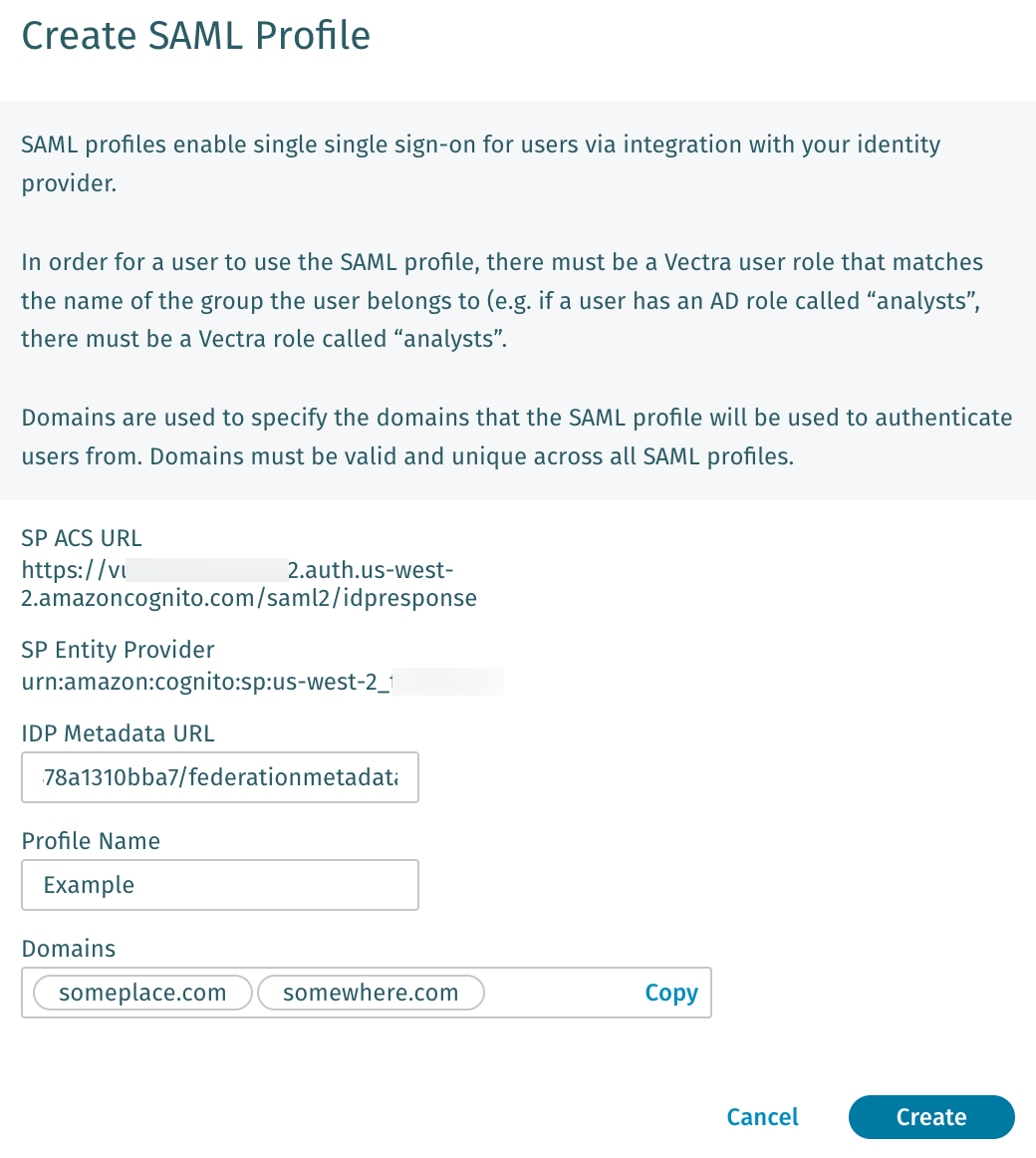
* Open a new browser tab and log in as you normally do and navigate to *Configuration → ACCESS → External Authentication*.
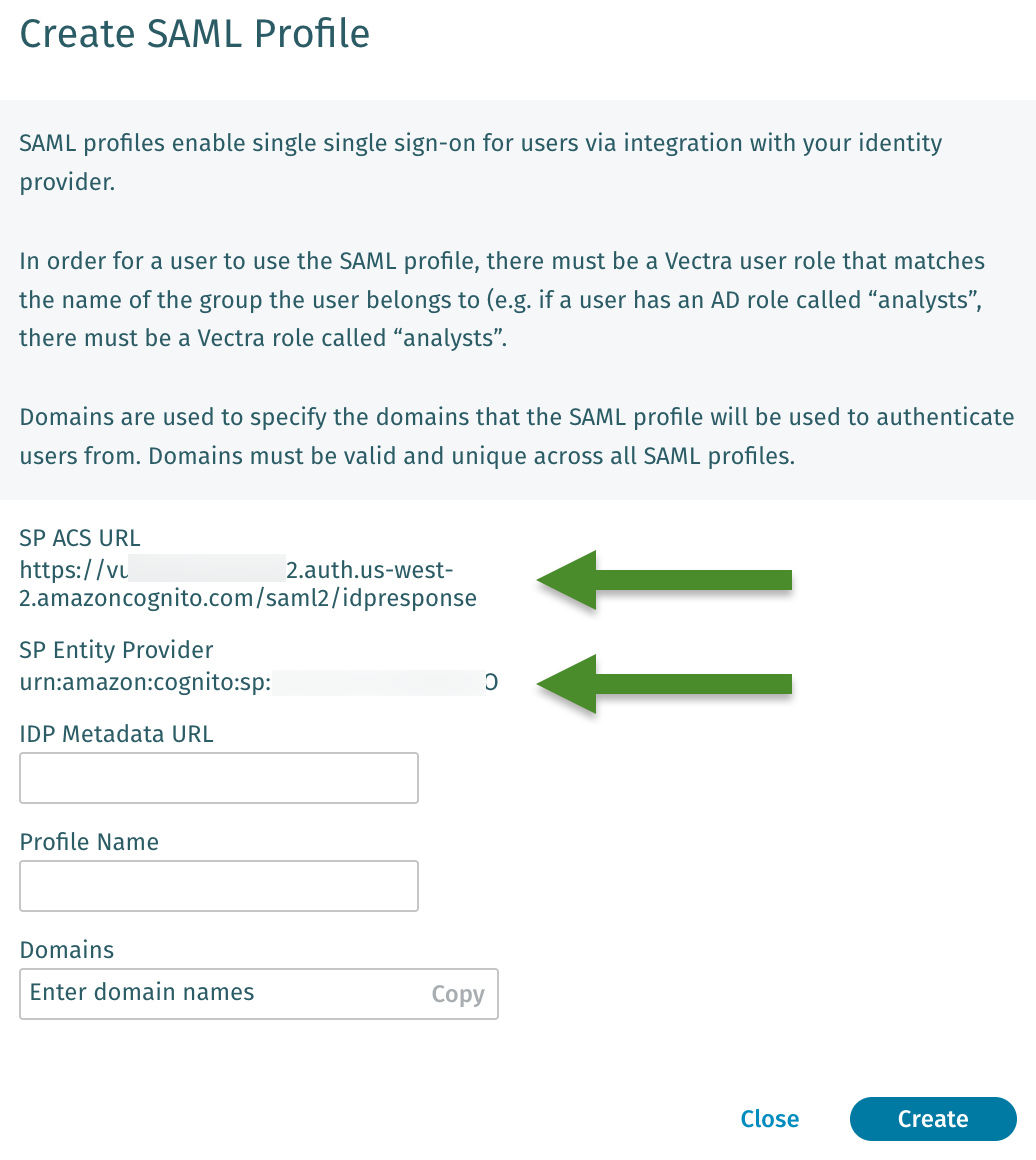
* Click on **Create** in the SAML Profiles section.

* A dialog will open and the **SP ACS URL** and **SP Entity Provider** will be displayed there for entry into the corresponding fields in the IdP. Make note of these values for later use with your IdP.
* The SP is the Service Provider (Vectra RUX tenant)
* Leave this tab in your browser open and proceed in another tab or window to your IdP configuration so that you can retrieve the **IdP Metadata URL** needed to complete the Vectra SaaS configuration.
## Gathering Standardized Role Names from Vectra UI
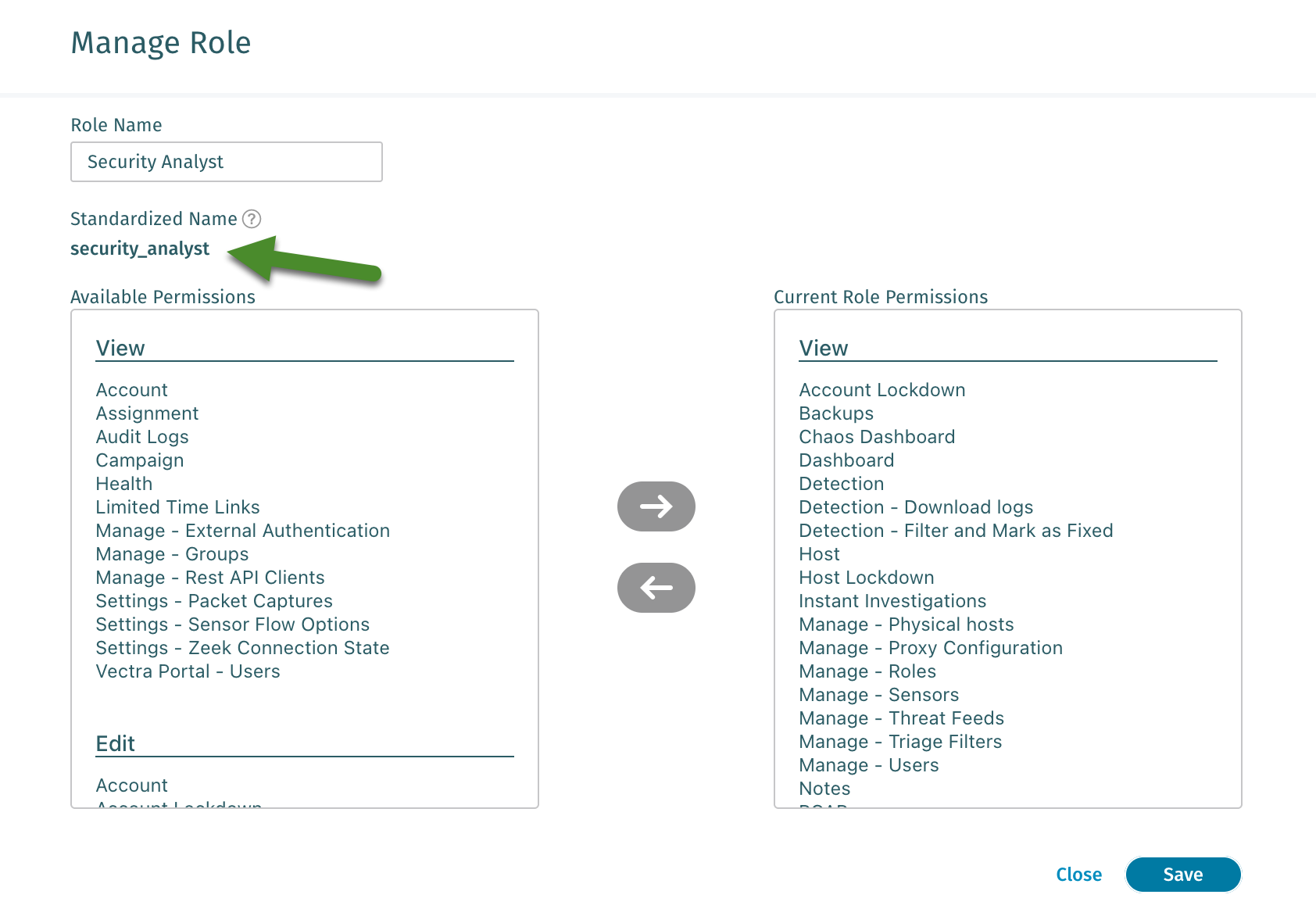
Navigate in your Vectra UI to *Configuration → ACCESS → Roles* and edit an entry:
In the above case we are examining the **Security Analyst** role (the **Role Name**) and you can see the **Standardized Name** is `security_analyst`.
{% hint style="warning" %}
**Please Note:**
* Role claims that are assigned in Keycloak that will be sent as part of a SAML assertion **MUST** use the standardized name from Vectra and not the role name.
* If the role name is used instead, the login will fail.
* Please note that only a single value is accepted for this value.
* If multiple roles are sent, the 1st one Vectra sees will be assumed to be the correct role for the user.
* At this time, the creation of custom roles is not supported in the Respond UX.
{% endhint %}
#### **Default standardized names for Vectra roles:**
| Role Name (DO NOT USE) | Standardized Name (USE) |
| ---------------------- | ----------------------- |
| Admin | `admins` |
| Auditor | `auditor` |
| Global Analyst | `global_analyst` |
| Read-Only | `read_only` |
| Restricted Admin | `restricted_admins` |
| Security Analyst | `security_analyst` |
| Setting Admin | `setting_admins` |
| Super Admin | `super_admins` |
* Make note of the standardized names for Vectra roles for later configuration as claims within Keycloak.
## Keycloak (IdP) Configuration Guidance
#### **Client Creation**
* In your Keycloak admin GUI, navigate to *Manage → Clients* and click **Create client**.

* Choose the **SAML** option for **Client type**.
* Paste in the **SP Entity Provider** you gathered earlier from the Vectra UI for the **Client ID**.
* Give this client a name and optional description and then click **Next** at the bottom.

* In the **Login settings** screen for your client, enter the following:
* For the **Home URL**, enter the URL of your Vectra RUX tenant.
* Paste in the **SP ACS URL** you gathered earlier from the Vectra UI for the **Valid redirect URIs** entry.
* Click **Save** at the bottom of your screen.

#### **Update Client Settings**
* You should be in the now more detailed settings for your client, if not, find your client in the list of clients and click on it to check and configure other options.
* The default **Settings** should be fine but in case they are ever changed, please ensure the **SAML capabilties** and **Signature and Encryption** settings are configured as in the below screenshot.

* In the **Keys** tab, the default has this configured but please ensure that **Client signature required** is unchecked as you see in the below screenshot:

#### **Add Roles to Client**
* Repeat as necessary for all Vectra roles you intend to use in your deployment:
* On the **Roles** tab, click **Create role** and enter the Vectra **Standardized Name** of a role you will map users or groups to and an optional description, and then click **Save**.

* You can leave the **Attributes** and **Users in role** blank for now.
* When done adding all the roles you will be using, you can see the list on the **Roles** tab of your client details.
* In our example below, we have 3 roles that we will be using:

#### **Modify Client Scope**
* Click into **Client scopes** and remove any entry except the scope dedicated to the client you are adding.
* In this example below, we are deleting the `role_list` entry.

* Click into the `urn:amazon:cognito...` entry that represents the client scope for your client.
* Click **Configure a new mapper**.

#### **Configure Mappers for the Roles**
* Configure the following 3 mappers:


* When done with this you should have something that looks like this:

* Move to the **Scope** tab and uncheck the **Full scope allowed** option so that it looks like this:
#### **Assign Role to Groups (repeat as necessary)**
* Now you simply need to go to your groups in Keycloak, find the group you wish to add the Vectra role to, and the assign the role to the group.
* In the below example we add the `super_admins` role to a test group.
* You will need to search by client/role that you added earlier.
* Repeat this to assign a Vectra role to each group you want to enable for SSO to your Vectra instance.


#### **Collect Metadata Retrieval URL for Vectra**
* Vectra will require the IdP metadata URL to allow download of the federation metadata that includes the signing certificate.
* In *Realm settings → General → Metadata* in Keycloak, you'll need to copy the **SAML 2.0 Identity Provider Metadata** URL and save this to complete the Vectra SAML authentication profile later.

* This will be input in the **IDP Metadata URL** box in the Vectra SAML authentication profile.
* This URL must be accessible from the internet so Vectra can retrieve the metadata required to complete the SAML profile.
## Completing Configuration in the Respond UX
* After IdP configuration and copying the IdP Metadata URL you can complete the configuration back in the Respond UX.
* Switch back to the browser tab or window with your Respond UX.
* Paste the IdP Metadata URL into the **Create SAML Profile** dialog box.
* Fill in the **Profile Name** with a name of your choice.
* Fill in the **Domains** field with the domains that should map to the SAML IdP you are configuring.
* When multiple SAML profiles are configured, users will enter an email address after clicking **Login with SSO**.
* Based on the user input and mapped domains, the user will be redirected to the appropriate IdP for authentication and then redirected back to Vectra with a SAML assertion.
* Click **Create**.
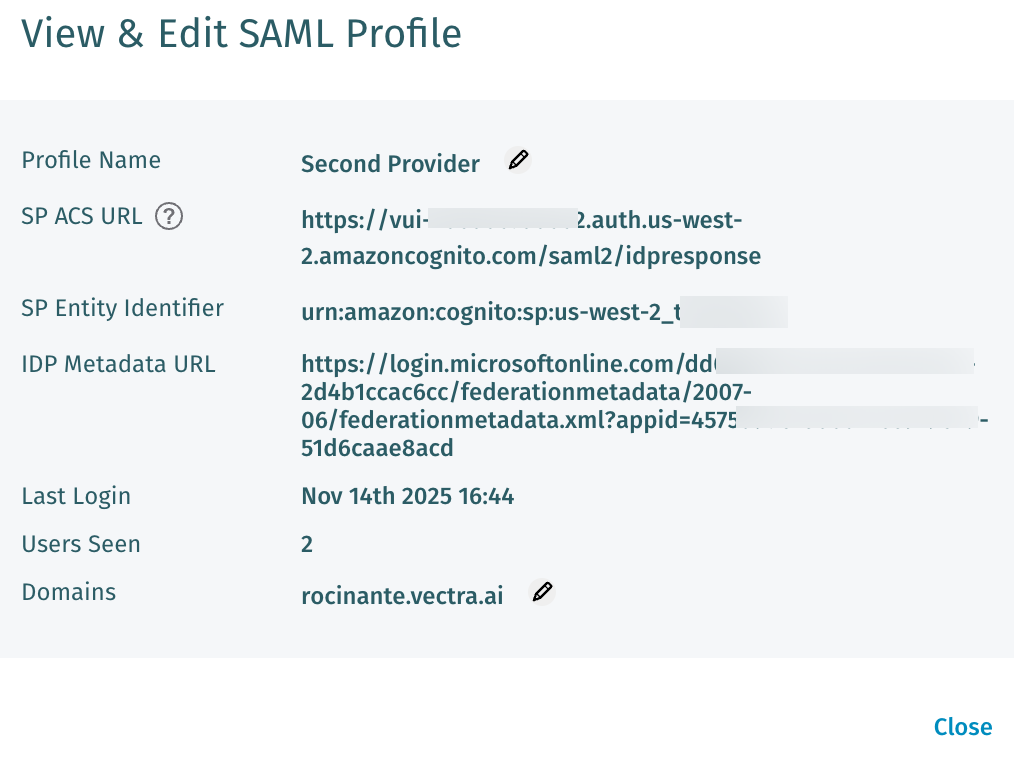
* Your SAML profile is now complete and will show in the Respond UX. Clicking on it will show the details similar to the below (this will vary by vendor and details provided).
* As you can see above, the Profile Name and Domains list can be edited for profiles that have already been configured.
* You can click the **View** link on a profile in the SAML Profiles list in your UI to get back to this screen.
## Testing
* Once configuration is complete on both the Service Provider (Vectra) and IdP side, you are ready to test SAML SSO to Vectra.
* Keep in mind that only users and groups who are mapped to standardized Vectra role names in your IdP will succeed.
* Click the **Login with SSO** button on the login page for your Vectra tenant.

* If you are already authenticated to your IdP, and have a mapping to a standardized role that exists in Vectra, you should be logged in without requiring any additional steps.
* If you are need to authenticate to your IdP, you will be asked for a email address when multiple profiles are configured and redirected to your IdP for authentication and then redirected back to Vectra and presented the UI mapped role permissions applied.
---
# Agent Instructions
This documentation is published with GitBook. GitBook is the documentation platform designed so that both humans and AI agents can read, navigate, and reason over technical content effectively. Learn more at gitbook.com.
## Querying This Documentation
If you need additional information that is not directly available in this page, you can query the documentation by asking a question.
Perform an HTTP GET request on the following URL with the `ask` and `goal` query parameters:
```
GET https://docs.vectra.ai/configuration/access/saml-sso-rux/keycloak-saml-rux.md?ask=&goal=
```
`ask` is the immediate question: it should be specific, self-contained, and written in natural language.
`goal` is what the user is ultimately trying to achieve, the reason they need the answer. Sharing it helps GitBook give you a better, more relevant answer. A goal is most helpful when it describes the outcome the user wants rather than restating the question. For example, with `ask=how do I create an API token`, a goal like `automate deployments from our CI pipeline` lets GitBook tailor the answer to that use case.
The response will contain a direct answer to the question and relevant excerpts and sources from the documentation.
Use this mechanism when the answer is not explicitly present in the current page, you need clarification or additional context, or you want to retrieve related documentation sections.
 ## Gathering Standardized Role Names from Vectra UI
Navigate in your Vectra UI to *Configuration → ACCESS → Roles* and edit an entry:
## Gathering Standardized Role Names from Vectra UI
Navigate in your Vectra UI to *Configuration → ACCESS → Roles* and edit an entry:
 #### **Assign Role to Groups (repeat as necessary)**
* Now you simply need to go to your groups in Keycloak, find the group you wish to add the Vectra role to, and the assign the role to the group.
* In the below example we add the `super_admins` role to a test group.
* You will need to search by client/role that you added earlier.
* Repeat this to assign a Vectra role to each group you want to enable for SSO to your Vectra instance.


#### **Collect Metadata Retrieval URL for Vectra**
* Vectra will require the IdP metadata URL to allow download of the federation metadata that includes the signing certificate.
* In *Realm settings → General → Metadata* in Keycloak, you'll need to copy the **SAML 2.0 Identity Provider Metadata** URL and save this to complete the Vectra SAML authentication profile later.

* This will be input in the **IDP Metadata URL** box in the Vectra SAML authentication profile.
* This URL must be accessible from the internet so Vectra can retrieve the metadata required to complete the SAML profile.
## Completing Configuration in the Respond UX
* After IdP configuration and copying the IdP Metadata URL you can complete the configuration back in the Respond UX.
* Switch back to the browser tab or window with your Respond UX.
* Paste the IdP Metadata URL into the **Create SAML Profile** dialog box.
* Fill in the **Profile Name** with a name of your choice.
* Fill in the **Domains** field with the domains that should map to the SAML IdP you are configuring.
* When multiple SAML profiles are configured, users will enter an email address after clicking **Login with SSO**.
* Based on the user input and mapped domains, the user will be redirected to the appropriate IdP for authentication and then redirected back to Vectra with a SAML assertion.
#### **Assign Role to Groups (repeat as necessary)**
* Now you simply need to go to your groups in Keycloak, find the group you wish to add the Vectra role to, and the assign the role to the group.
* In the below example we add the `super_admins` role to a test group.
* You will need to search by client/role that you added earlier.
* Repeat this to assign a Vectra role to each group you want to enable for SSO to your Vectra instance.


#### **Collect Metadata Retrieval URL for Vectra**
* Vectra will require the IdP metadata URL to allow download of the federation metadata that includes the signing certificate.
* In *Realm settings → General → Metadata* in Keycloak, you'll need to copy the **SAML 2.0 Identity Provider Metadata** URL and save this to complete the Vectra SAML authentication profile later.

* This will be input in the **IDP Metadata URL** box in the Vectra SAML authentication profile.
* This URL must be accessible from the internet so Vectra can retrieve the metadata required to complete the SAML profile.
## Completing Configuration in the Respond UX
* After IdP configuration and copying the IdP Metadata URL you can complete the configuration back in the Respond UX.
* Switch back to the browser tab or window with your Respond UX.
* Paste the IdP Metadata URL into the **Create SAML Profile** dialog box.
* Fill in the **Profile Name** with a name of your choice.
* Fill in the **Domains** field with the domains that should map to the SAML IdP you are configuring.
* When multiple SAML profiles are configured, users will enter an email address after clicking **Login with SSO**.
* Based on the user input and mapped domains, the user will be redirected to the appropriate IdP for authentication and then redirected back to Vectra with a SAML assertion.
 * Click **Create**.
* Your SAML profile is now complete and will show in the Respond UX. Clicking on it will show the details similar to the below (this will vary by vendor and details provided).
* Click **Create**.
* Your SAML profile is now complete and will show in the Respond UX. Clicking on it will show the details similar to the below (this will vary by vendor and details provided).
 * As you can see above, the Profile Name and Domains list can be edited for profiles that have already been configured.
* You can click the **View** link on a profile in the SAML Profiles list in your UI to get back to this screen.
## Testing
* Once configuration is complete on both the Service Provider (Vectra) and IdP side, you are ready to test SAML SSO to Vectra.
* Keep in mind that only users and groups who are mapped to standardized Vectra role names in your IdP will succeed.
* Click the **Login with SSO** button on the login page for your Vectra tenant.

* If you are already authenticated to your IdP, and have a mapping to a standardized role that exists in Vectra, you should be logged in without requiring any additional steps.
* If you are need to authenticate to your IdP, you will be asked for a email address when multiple profiles are configured and redirected to your IdP for authentication and then redirected back to Vectra and presented the UI mapped role permissions applied.
* As you can see above, the Profile Name and Domains list can be edited for profiles that have already been configured.
* You can click the **View** link on a profile in the SAML Profiles list in your UI to get back to this screen.
## Testing
* Once configuration is complete on both the Service Provider (Vectra) and IdP side, you are ready to test SAML SSO to Vectra.
* Keep in mind that only users and groups who are mapped to standardized Vectra role names in your IdP will succeed.
* Click the **Login with SSO** button on the login page for your Vectra tenant.

* If you are already authenticated to your IdP, and have a mapping to a standardized role that exists in Vectra, you should be logged in without requiring any additional steps.
* If you are need to authenticate to your IdP, you will be asked for a email address when multiple profiles are configured and redirected to your IdP for authentication and then redirected back to Vectra and presented the UI mapped role permissions applied.